
Add your title here
This is the text area for this paragraph. To change it, simply click and start typing. Once you've added your content, you can customize its design by using different colors, fonts, font sizes and bullets. Just highlight the words you want to design and choose from the various options in the text editing bar.
This is the text area for this paragraph. To change it, simply click and start typing. After adding your content, you can customize it.
Saving a Tooth When the Pulp Is Compromised
Root canal treatment in Scarborough for infection or inflammation inside the tooth that is causing pain or threatening the tooth's survival
What changes after a root canal is completed is straightforward: the pain that was tracking from the tooth into the jaw, face, or surrounding teeth stops because the source of that pain — infected or inflamed pulp tissue — has been removed and the canals have been sealed. Nathan Goff DMD performs root canal treatment in Scarborough for patients who are dealing with a toothache that does not resolve, sensitivity that lingers long after a hot or cold stimulus is removed, or visible swelling near a tooth that has been cracked, deeply decayed, or repeatedly restored. These are the conditions that indicate the pulp has been compromised and cannot recover on its own.
The procedure involves accessing the pulp chamber through an opening in the crown of the tooth, removing the pulp tissue from the chamber and each canal, shaping the canals with fine instruments so they can be thoroughly cleaned, and filling them with a material called gutta-percha that seals the space against reinfection. The number of canals varies by tooth — molars typically have three or four, while front teeth generally have one — and each canal must be located, shaped, and filled for the treatment to be complete.
If you are dealing with persistent tooth pain, prolonged sensitivity, or swelling near a specific tooth, schedule an evaluation with Nathan Goff DMD to determine whether root canal treatment is the appropriate course of action.
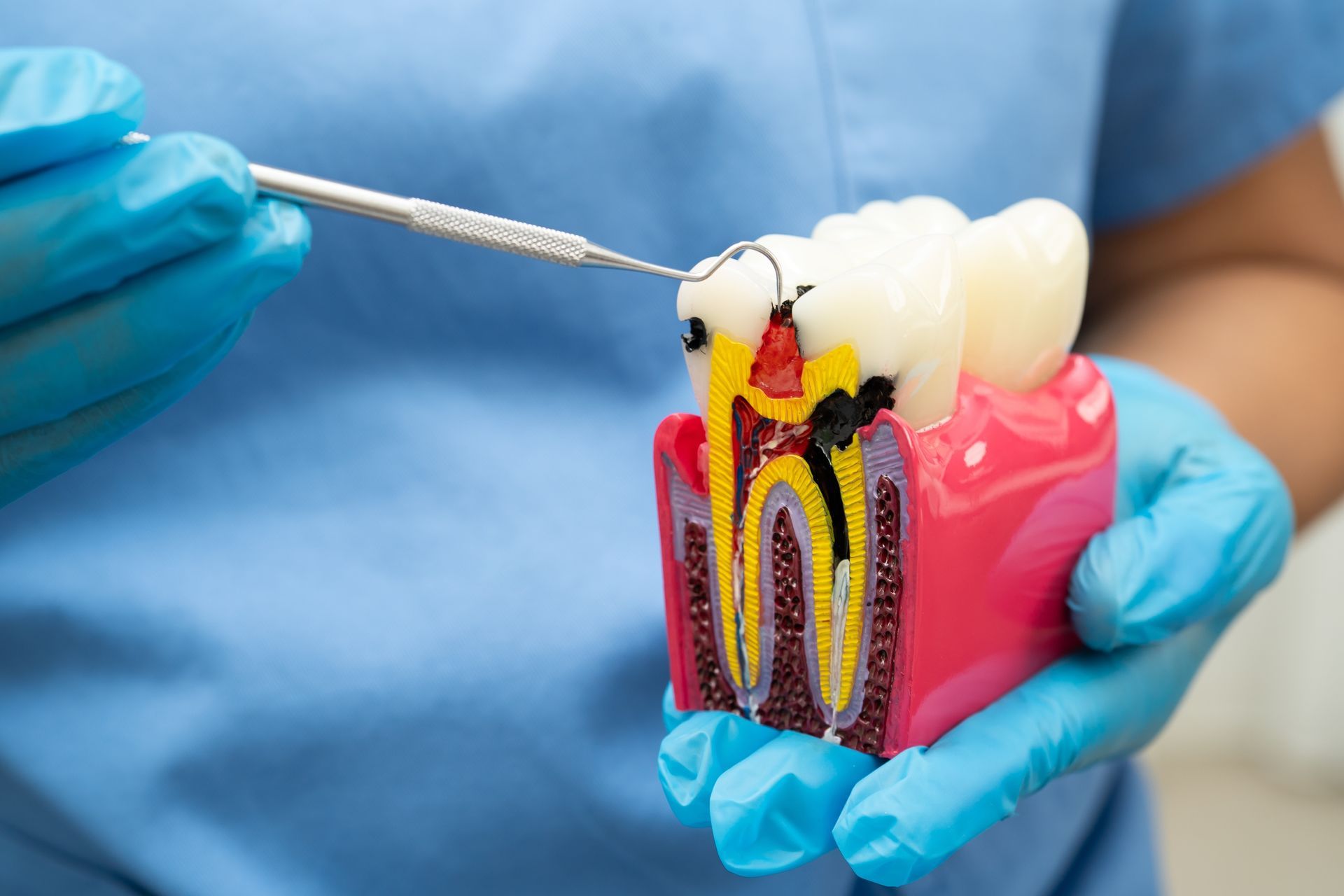
A common misunderstanding about root canal treatment is that it weakens the tooth. What the procedure removes is the pulp — the soft tissue inside the tooth that contains nerves and blood vessels — while leaving the surrounding dentin and enamel structure intact. The tooth remains in the jaw, continues to occupy its position in the arch, and continues to support the adjacent teeth. The alternative, extraction, removes the entire tooth and introduces the downstream problems that come with an open space in the arch unless an implant or bridge is placed afterward.
After root canal treatment is complete, the tooth typically requires a crown, because the access opening and the pre-existing damage from decay or fracture leave the remaining tooth structure more vulnerable to cracking under normal bite forces. A tooth that has been through root canal treatment without a crown placed afterward is at meaningful risk of fracturing in a way that makes the tooth unrestorable. Nathan Goff DMD discusses this restoration step as part of the overall treatment plan so patients understand what the full process involves before it begins.
Some root canals require more than one appointment depending on the severity of the infection. When an abscess is present or the infection has spread into surrounding bone, an initial appointment may focus on drainage and disinfection, with the canal filling completed at a follow-up visit once the acute infection has been controlled. This sequencing is a clinical decision based on what is found at the initial evaluation, not a default protocol applied to every case.
Questions About How Root Canal Treatment Works
The questions below address what root canal treatment involves mechanically, how the procedure is sequenced, and what you will notice once treatment is finished.
How does a dentist locate all of the canals inside a tooth during treatment?
A combination of magnification, tactile instruments, and apex locators — electronic devices that measure the length of each canal to its tip — are used to confirm that every canal has been identified and treated to the correct working length before the filling material is placed.
What is gutta-percha and why is it used to fill the canals?
Gutta-percha is a rubber-like material derived from a tropical tree that is biocompatible with surrounding tissue, dimensionally stable over time, and able to be compacted into the irregular shapes of root canals using heat and pressure to create a dense, bacteria-resistant seal.
Why does a tooth that has had a root canal still need a crown afterward?
The access preparation and the original damage that required treatment leave the remaining walls of dentin without the internal support that the pulp tissue previously provided, making the tooth prone to vertical fracture under bite forces — a crown distributes that force across the entire tooth surface.
How is root canal treatment different in a molar than in a front tooth?
Molars absorb significantly higher bite forces and contain multiple canals that may curve or divide, making the procedure more anatomically complex and more likely to require extended appointment time or multiple visits compared to single-rooted front teeth.
What are the signs that a root canal was needed rather than a simpler treatment?
Pulp that is irreversibly inflamed or necrotic produces symptoms that distinguish it from a cavity — lingering heat sensitivity, spontaneous pain, pain that wakes you at night, or swelling at the root tip visible on an X-ray as a darkened area called a periapical lesion.
Nathan Goff DMD can evaluate a tooth that has been causing persistent symptoms and explain whether root canal treatment is indicated, what the procedure involves for that specific tooth, and what restoration follows once the canals are sealed.